
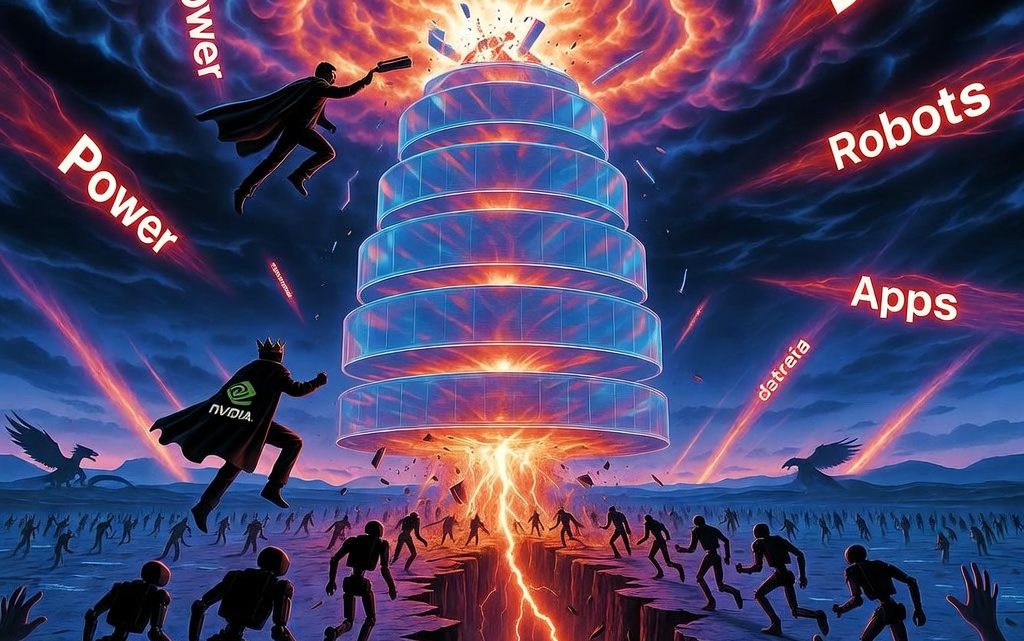
5-layer AI revolution by nVidia
January 29, 2026Jensen Huang: AI’s 5-Layer Revolution, China’s Edge & US Wake-Up
Introduction: A Visionary’s Blueprint for AI’s Future
In a recent interview that has reverberated through tech circles, Nvidia CEO Jensen Huang unveiled a sweeping vision of artificial intelligence not as a singular breakthrough, but as a towering “five-layer cake” poised to reshape global economies, industries, and societies. Huang, whose company powers the AI revolution through its dominance in chips and software, dissected the ecosystem with surgical precision: from energy at the base to transformative applications at the top. His remarks cut through the hype, warning of China’s accelerating lead and urging the US to confront its vulnerabilities in energy, infrastructure, and societal mindset. This article unpacks Huang’s insights, analyzes their implications from technological, economic, geopolitical, and cultural lenses, draws parallels to historic inflection points, and speculates on futures that could redefine power balances worldwide. As Huang puts it, “Who applies first wins” a mantra echoing the industrial revolutions of old.
The Five-Layer AI Platform: Building the Foundation
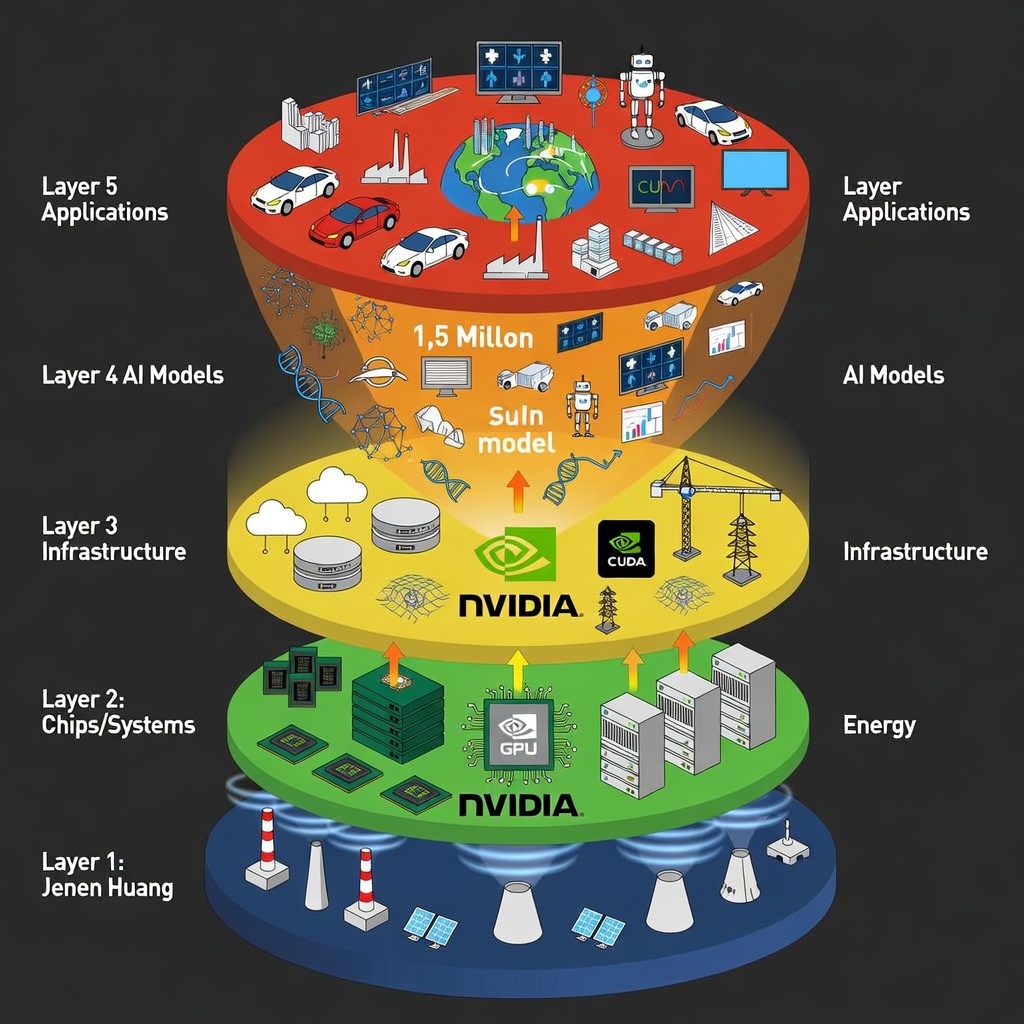
Huang structures the AI ecosystem as a multi-layered platform, each stratum interdependent and essential for the whole. At the base lies Layer 1: Energy, the unsung hero without which no AI ambition can scale. Chips and systems form Layer 2, where Nvidia reigns supreme. Layer 3: Infrastructure encompasses software like CUDA, cloud services, land acquisition, power grids, and financial ecosystems. Layer 4: AI Models explodes with 1.5 million worldwide, infiltrating domains from genes and proteins to physics, quantum computing, robotics, finance, and healthcare. Finally, Layer 5: Applications delivers real-world impact in healthcare diagnostics, entertainment, manufacturing, self-driving cars, and transportation.
This layered model isn’t abstract it’s a dependency chain. Nvidia positions itself at Layers 2 and 3, providing CUDA (a 25-year-old architecture that’s become AI’s universal language) and libraries that enable every major player, from self-driving pioneers like Waymo to drug discovery firms like Insilico Medicine. Huang emphasizes Nvidia’s agnosticism: “We work with every self-driving car company… every drug discovery company.” By not chasing end-user apps, Nvidia becomes the indispensable platform, much like Intel in the PC era or ARM in mobile.
From a technological perspective, this framework reveals AI’s maturation beyond chatbots (ChatGPT, Claude, Gemini, Grok represent just four of 1.5 million models). It’s interdisciplinary fusion: AI decoding long-sequence patterns in finance, multi-modal data in healthcare, or physical laws in quantum simulations. Speculatively, this breadth foreshadows an “AI everywhere” era, where domain-specific models compound into exponential gains imagine physics-informed AI optimizing fusion reactors or protein-folding models slashing drug development from years to months.
US-China AI Race: Handicaps and Hidden Strengths
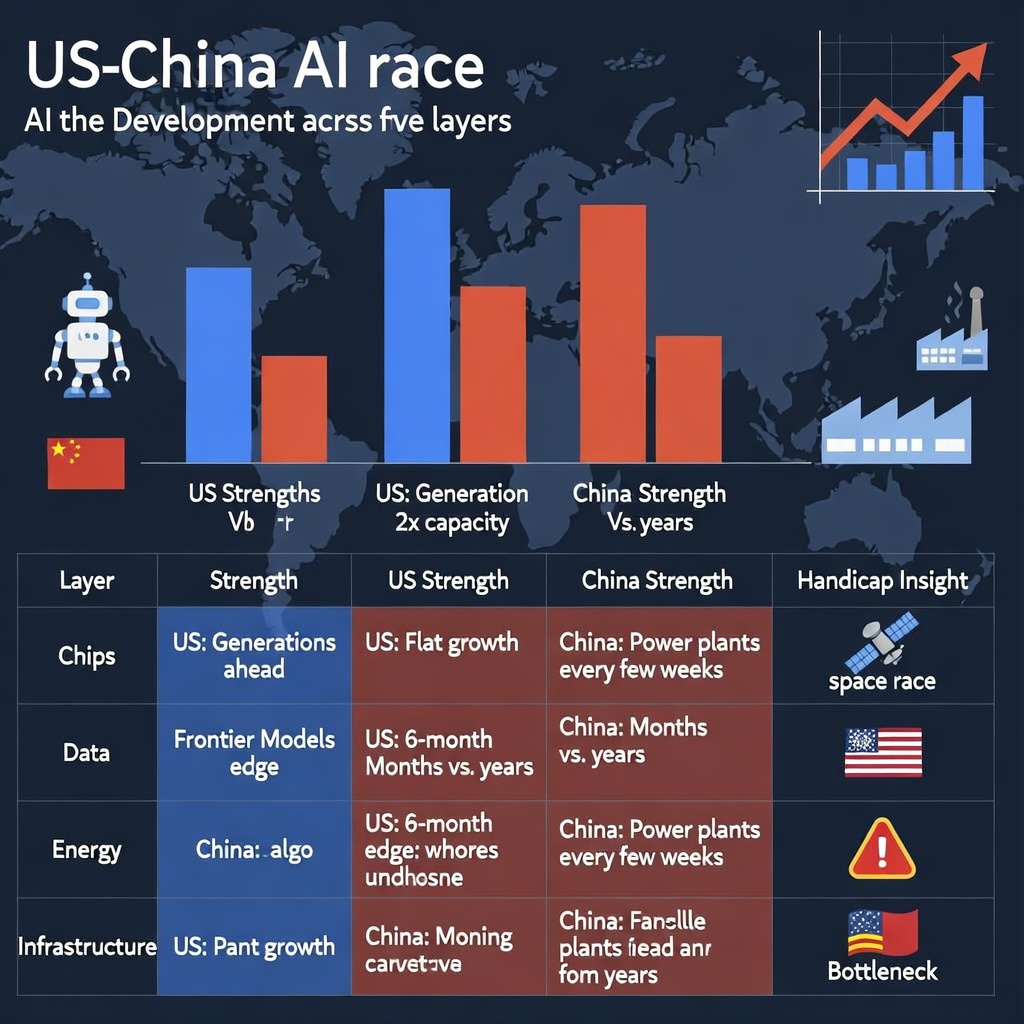
Huang’s analysis of the US-China rivalry is unflinching, framing it as a comparative “handicap” across layers. The US holds insurmountable leads in chips (generations ahead) and frontier models (a six-month edge), but China dominates elsewhere: twice the US energy capacity despite a smaller economy, blistering infrastructure velocity (data centers in months vs. US’s three years “they build a hospital in a weekend”), open-source model proliferation, robotics deployment (half of the world’s 2 million robots), mechatronics expertise, and societal optimism.
| Layer | US Strength | China Strength | Handicap Insight | ||
|---|---|---|---|---|---|
| Energy | Lagging (flat growth) | 2x US capacity | US vilified energy historically; no power, no AI factories. | ||
| Chips/Systems | Generations ahead | Catching up | Nvidia’s moat, but manufacturing threats loom. | ||
| Infrastructure | Strong software/cloud | Speed (months vs. years) | China’s “builder culture” accelerates deployment. | ||
| AI Models | Frontier leads | Open-source dominance | 1.5M models; China enables startups/research. | ||
| Applications | Innovation hubs | Robotics scale, optimism | Fear slows US adoption. |
Geopolitically, this isn’t bravado it’s quantified. China’s edges compound via cause-effect chains: abundant energy fuels rapid infrastructure, which deploys open-source models faster, birthing applications in robotics and manufacturing. The US, Huang warns, risks self-sabotage through energy shortages delaying chip fabs, supercomputers, and AI data centers critical for reshoring.
Comparatively, this mirrors the space race of the 1960s, where the US’s Apollo triumphs masked Soviet leads in launch cadence and heavy lift (e.g., N1 vs. Saturn V). Just as Kennedy’s moonshot pivoted America to victory, Huang calls for a US “policy pivot”: pro-energy initiatives (nodding to Trump-era deregulation) to unleash re-industrialization. Without it, China could replicate the Soviet Union’s early momentum, but with economic heft to sustain dominance.
Societal Perceptions: Fear vs. Optimism in the AI Mindset
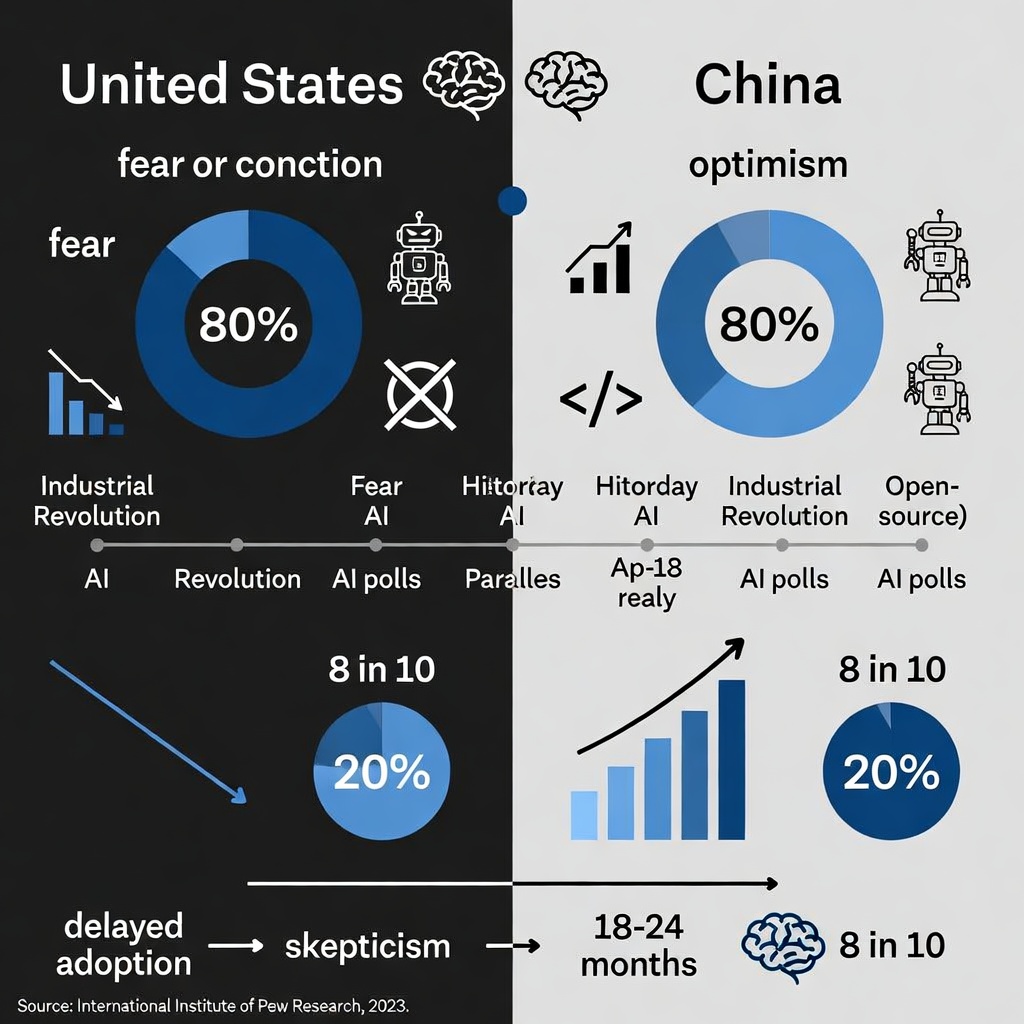
Polling data underscores a cultural chasm: 80% of Chinese view AI as more beneficial than harmful, versus the US reverse. Huang decries US “sci-fi fearmongering” dystopian narratives breeding complacency. “Concern yes, but practical,” he insists, urging focus on automation’s inevitability over Skynet fantasies.
Culturally, this divide echoes Luddite resistance during the Industrial Revolution (1811-1816), where British textile workers smashed machines fearing job loss, delaying adoption while competitors surged. Today, US fear could cede the “who applies first” race, much as Europe’s regulatory caution let the US dominate PCs and the internet. China’s optimism, fueled by labor shortages and manufacturing imperatives, drives rapid diffusion open-source as the great equalizer, akin to Linux enabling Android’s global explosion.
Speculatively, a US societal shift toward “practical optimism” could flip polls in 18-24 months, accelerating applications. But persistent fear risks a feedback loop: delayed adoption → fewer wins → reinforced skepticism.
Robotics and Embodiment: From Pixels to Physical Reality
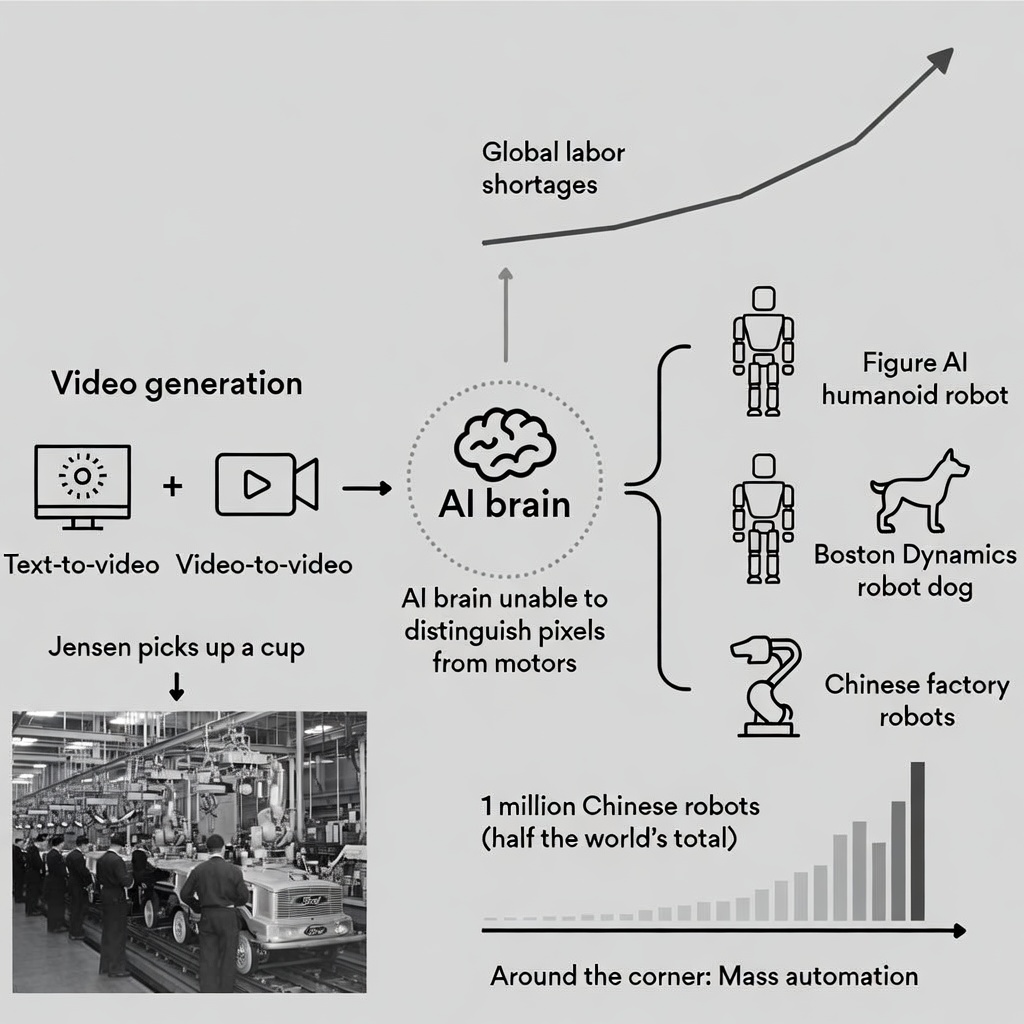
Huang’s most provocative claim: AI’s mastery of video generation (manipulating pixels) seamlessly transitions to robotics (manipulating motors). “AI can’t distinguish between pixels and motors,” he says text-to-video like “Jensen picks up a cup” is mere prelude to cloud AI embodying edge robots. With labor shortages worldwide, this “around the corner” shift promises mass autonomy.
Technologically, it’s a paradigm leap: from disembodied language models to physical agents. China’s 1 million robots (half global total), mechatronics prowess, and demand from aging demographics position it for dominance. US strengths in software could counter via integrations like Figure AI or Boston Dynamics, but scale lags.
This parallels Henry Ford’s assembly line (1913), automating labor amid shortages, birthing the auto industry. Robotics explosion could resolve global worker gaps but trigger “horrifying job loss,” per Huang factories staffed by tireless machines, reshaping economies.
Policy and Industrial Imperatives: Energy as the Bottleneck
Huang lambasts past US energy vilification, linking flat growth to stalled AI factories. Pro-energy policy deregulation, nuclear revival unlocks chains: energy → infrastructure → models → applications → jobs/growth. Reshoring manufacturing demands this, countering China’s velocity.
Economically, open-source is non-negotiable: without it (Linux, Kubernetes, PyTorch), no thriving startups, universities, or industries. China’s lead here stifles US ecosystems, echoing Microsoft’s early Windows monopoly before open-source challengers democratized software.
Future Impacts: Scenarios and Speculations
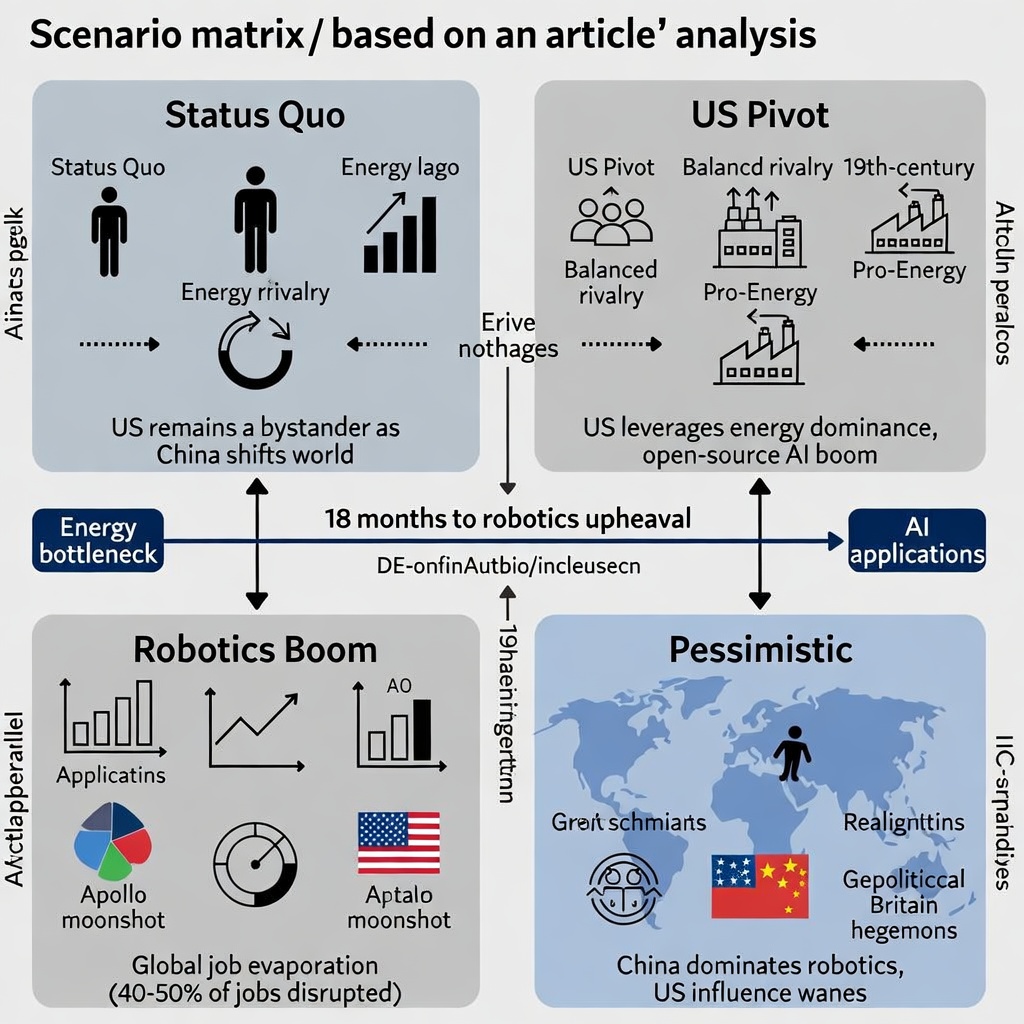
Huang’s timeline is aggressive: 18 months for robotics upheaval, platforms igniting 1.5M models into applications. Possible outcomes vary:
| Scenario | US Trajectory | China Trajectory | Global Impact | ||
|---|---|---|---|---|---|
| Status Quo | Energy/infra lag; fear persists → AI bystander. | Energy/robotics surge → World order shift. | China-led revolution; US de-industrializes. | ||
| US Pivot | Pro-energy/open-source → Factory boom, practical apps. | Sustained edges in velocity/mechatronics. | Balanced rivalry; innovation fusion. | ||
| Robotics Boom | Partial automation amid reshoring. | Scales to millions → Manufacturing monopoly. | Jobs evaporate; UBI debates intensify. | ||
| Pessimistic | Complacency → Chip lead erodes. | Full-stack dominance. | Geopolitical realignment; US influence wanes. |
Speculatively, a robotics explosion resolves labor shortages but disrupts 40-50% of jobs (McKinsey estimates), spurring UBI trials and reskilling. Geopolitically, China’s win could mirror Britain’s 19th-century hegemony, exporting AI standards worldwide. Optimistically, US action sparks a “second Apollo,” blending chips/models with renewed energy/infra for hybrid leadership.
Conclusion: Platforms Enable, Applications Conquer
Jensen Huang’s interview is a clarion call: AI’s five-layer revolution demands holistic strength, not siloed excellence. Platforms like Nvidia universalize tech; applications decide victors. China’s edges energy, speed, optimism threaten to upend balances unless the US pivots practically, shedding fears for action. Like the steam engine or electricity, this transformation will “deeply affect” humanity. The race is on who builds the factories, deploys the robots, and embraces the future first? History favors the bold.
it sounds a lot like a polished sales pitch for Nvidia’s dominance. Huang is brilliant at framing the narrative, but I find this obsession with “layers” a bit convenient. It conveniently places Nvidia at the center of everything while painting a picture of a looming dystopia that justifies the massive spending required to keep the lights on.
I’m particularly skeptical about the “pixels to motors” transition. It’s a flashy line that sounds amazing in a keynote, but in my experience with tech implementation, the “last mile” of physical robotics is a nightmare of edge cases, sensor noise, and mechanical failure that a LLM can’t just “reason” its way through. We are jumping from “AI can write a poem” to “AI will run our entire manufacturing infrastructure” with a level of optimism that borders on the delusional.
And the US-China “handicap” talk? It feels like a convenient way to manufacture urgency. If we’re really looking at a revolution, the bottleneck isn’t just “societal fear” or “energy capacity” it’s the actual viability of these models to create tangible ROI beyond just generating high-quality noise.
I’ve seen how companies try to bake these “transformative” tools into their workflows, and often it’s just a layer of shiny paint over old problems. Even agencies that lean into the tech, like Holik Studios, have to deal with the reality that data-driven content and new tools only work if the underlying strategy isn’t flawed. You can have the best “Layer 4” model in the world, but if your “Layer 5” application doesn’t actually solve a human problem, it’s just an expensive paperweight.
Are we actually building a new industrial revolution, or are we just building a very expensive, very complex mirror that reflects our own technological insecurities?